
What We Do
Our Programs
Sight
Centre for Eye Research Australia
The Victorian Lions Foundation is a partner in CERA. The Centre for Eye Research Australia operates as part of the Department of Ophthalmology of the Melbourne University at the Eye and Ear Hospital in Melbourne.
The foundation supports and funds a research fellow at the Centre for Eye Research. Lions (through the VLF) are part of the members forum at CERA.
Lions Eye Donation Service Celebrates 25 Years of Saving Sight
Lions Eye Donation Service - Melbourne
A Fund was established to pay the running costs of the Victorian Lions Eye Donation Service which is located at the Centre for Eye Research. The Eye Donation Service operates as part of the Department of Ophthalmology of the Melbourne University at the Eye and Ear Hospital in Melbourne. The foundation also supports CERA, the Centre for Eye Research Australia Limited.
National Vision research Institute
Lions Vision Research Fellow is funded to research problems with vision, particularly those associated with aging. National Vision Research Institute is affiliated with the University of Melbourne and Monash University, studying "The Eye from Birth to Old Age".
Hearing Research Fellow
For over 25 years the Victorian Lions Foundation has supported a Lions International Hearing Research Fellow at the Bionics Institute. The Fellowship provides an opportunity to a mid-level researcher to work specifically in an area of importance in bionic hearing, or deafness for a period of approximately two years.
The Fellowship has always been outcome focused with research examples including, training older children with a bionic ear to communicate and accelerate their learning, investigating speech perception in noisy environments to improve the quality of hearing and a current study into improving the sound quality of music for those with a bionic ear.
The current Lions Hearing Research Fellow is improving outcomes for hearing impaired people by determining ways to predict their speech perception outcomes using hearing devices.
Neurobionics Research Fellow
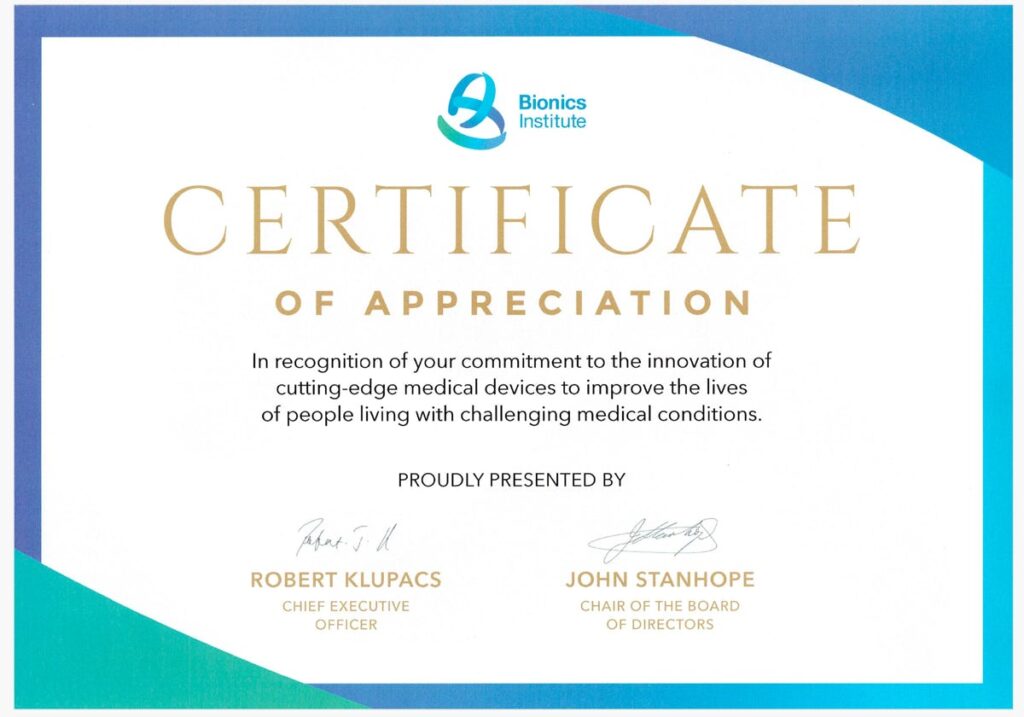
Lions are funding an exciting new research program at the Bionics Institute which is based on their 30 years of experience. Our Neurobionics Fellow will take a central role in the development of implantable brain stimulation devices that will provide treatment for severe neurological and psychiatric conditions such as Parkinson’s disease, epilepsy, obsessive-compulsive disorder, and other conditions. The Institute’s first Lions International Neurobionics Fellow is working with our engineers and scientists to develop and evaluate advanced deep brain stimulation systems to treat movement disorders such as essential tremor and Parkinson’s Disease.
You can find out more at www.bionicsinstitute.org.
The Lions International Neurobionics Research Fellowship project is an initiative of the Lions Club of Balla Balla in the MD201V3 District that was adopted as a national Category B project in 2013 and renewed for a further 3 years in 2014.
The Neurobionics Fellow will work with the neurobionics research team at the Bionics Institute to explore implant devices that monitor neural activity in the brain, spinal cord, or elsewhere in the body, and/or stimulate nerves electrically for therapeutic applications. The focus is on realworld applications to alleviate common disorders like epilepsy and blackouts, movement disorders including Parkinson's disease and essential tremor, and certain severe psychiatric conditions such as obsessive compulsive disorder.
Following a national appeal to Clubs, over $250,000 has been raised. The first Neurobionics Fellow has been appointed and a Neurobionics Clinical Laboratory has been established at St Vincent's Hospital, Melbourne. The initial research is on Deep Brain Stimulation for Parkinson's Disease.
The first Neurobionics Fellow to be appointed is Dr Wesley Thevathasan: Dr Thevathasan undertook his medical degree and neurological training in Melbourne. He then further specialised in movement disorders and deep brain stimulation at the National Hospital, Queen Square, London and the John Radcliffe Hospital, Oxford. He was appointed honorary consultant neurologist at Oxford where he managed the deep brain stimulation of hundreds of patients.
After helping develop a new form of deep brain stimulation for Parkinson’s disease (PPN DBS), he received a doctorate from the University of Oxford. Dr Thevathasan currently holds an NHMRC research fellowship and project grant to advance the effectiveness of deep brain stimulation. He sits on international committees creating guidelines for DBS. He guides DBS implantation at major public hospitals in Melbourne (RMH, Austin, St Vincents) and consults privately at Cabrini Hospital (Malvern) and Melbourne Private Hospital (Parkville).
Dr Thevathasan is working on Deep Brain Stimulation (DBS) to directly improve movement including slowness, stiffness, tremor, walking difficulties and involuntary movement (dyskinesias). This can reduce the need to take Parkinson's medication. DBS does not directly improve non-movement issues such as intellect, sleep disturbance or bladder function. DBS does not cure Parkinson's disease or slow progression of the disease. The aim of DBS is to improve quality of life — and can remain beneficial over the long term (e.g. over 10 years). Research underway in collaboration with the Bionics Institute includes the investigation of new target sites for electrode placement, and the development of a 'closed-loop' stimulator system to more accurately titrate the
therapeutic stimulation.
The project is off to a great start, but Lions still have work to do. Our target is to raise a total of $1 million that will enable the Bionics Institute to continue its research in Neurobionics into the future to improve the quality of life for many members of our community. If every Club in MD201 contributes $1000 we will get there this year!
Dr Thevathasan's research is already having a clinical impact. Let's help him to keep up the good work.
Lions Rheumatism and Arthritis Medical Research Foundation
The Victorian Victorian Lions Foundation Inc. was established by the Lions Clubs of Victoria and Southern New South Wales, to support the development of Health and Welfare Programmes for the benefit of the population within the five Lions Club Districts encompassing Victoria and Southern New South Wales.
The primary role of the Foundation is to create a Capital Fund to support the creation of major programmes through liaison with Lions Clubs, Charitable Trusts and Corporations.
The latest donation from Lions Clubs of $78000.00 plus funds from Monash was made to purchase a Tecan Microplate Reader.
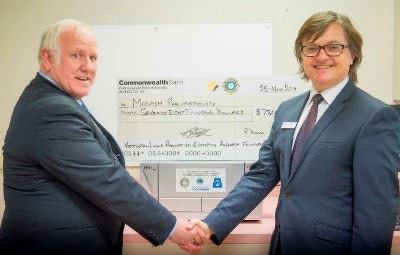
Eric Gittins and SCS Head Prof Eric Morand with the M1000 Pro multifunction plate reader
28 Nov 2014
Rheumatoid arthritis patients will benefit from research enabled by state of the art equipment donated by the Lions Club to the School of Clinical Sciences at Monash Health (SCS).
Thanks to the generous donation of $78,000 from the Victorian Lions Club, Australian Lions Foundation and Lions Clubs International Foundation, the Arthritis Research Group in the Centre for Inflammatory Diseases at SCS has been able to purchase a Tecan M1000 Pro multifunctional plate reader.
The Victorian Lions Club has been raising funds for over 30 years for the Victorian Lions Rheumatism & Arthritis Medical Research Foundation," said Lions Club representative and Past District Governor Mr Eric Gittins. "In the last 12 years we have donated well over $300,000 to Monash University for various equipment and facilities."
"We understand that this equipment will facilitate a faster translational response to testing carried out in the laboratory."
Arthritis Research Group leader Dr James Harris said, "this high-end technology allows us to perform multiple types of assays using the one machine.""We can use it for both functional and clinical assays, such as ELISA, luminescence and fluorescence-based protocols."
In lay terms, the new equipment will now allow researchers to perform multiple experiments without having to use different machines for each.
"Now we have this technology in one machine in our lab, we can increase both efficiency and functionality; it lets us design completely new types of studies," added Dr Harris.
Some of the assays used in the laboratory measure levels of immune system proteinsin biological samples, including blood (serum) and cell culture samples.
"In the clinical context, we use assays to look for biomarkers or correlates of disease in arthritis and lupus," said Head of rheumatology at Monash Health, Professor Eric Morand, also Head of SCS.
The new equipment allows scientists to more swiftly develop important insights into the biological mechanisms of arthritis and rheumatic diseases and push their discoveries towards the development of new drugs.
"Overall, it is an incredibly powerful tool that will not only make our day-to-day experiments quicker and more efficient, but will also allow us to expand our repertoire of assays and even design our own."
The Lions Rheumatism and Arthritis Medical research Foundation Australia Website
International Diabetes Institute
The Foundation supports the Lions Diabetes Education Wing.
For more information go to the Baker International Diabetes Institute Web Site.